


Retired General MJP Hutagaol Highlights the Relationship Between Capital and Power in Modern Democracy
- account_circle Suwoto
- calendar_month Kamis, 18 Jun 2026
- visibility 223
- comment 0 komentar
- print Cetak

info Atur ukuran teks artikel ini untuk mendapatkan pengalaman membaca terbaik.
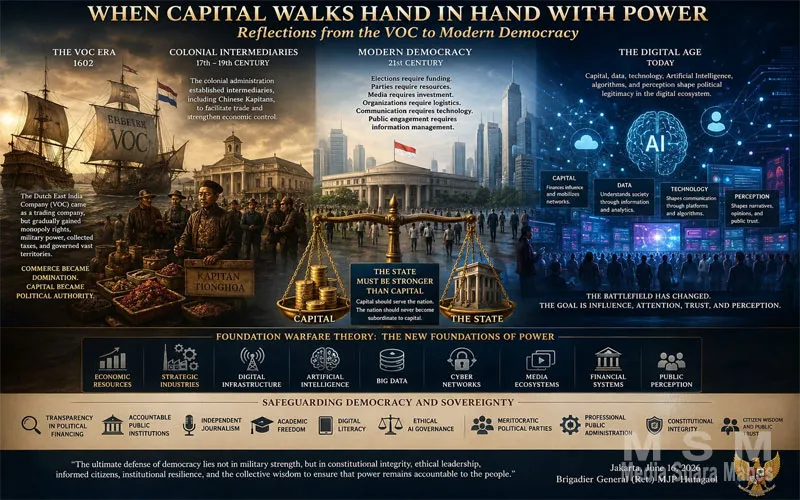
Jakarta, MediaSuaraMabes.co.id – Retired Brigadier General MJP Hutagaol has released a reflective essay titled “When Capital Walks Hand in Hand with Power: Reflections from the VOC to Modern Democracy,” examining the relationship between capital, technology, data, and political influence in modern democratic systems.
Published in Jakarta on June 16, 2026, the essay draws historical lessons from the Dutch East India Company (VOC), which initially arrived in the Indonesian archipelago as a trading corporation but later evolved into a powerful political and governing institution.
According to Hutagaol, history demonstrates that a nation’s sovereignty is not always lost through open warfare. Influence over state affairs can gradually emerge through economic power, trade monopolies, strategic investments, and the accumulation of capital capable of shaping public policy and political authority.
“Commerce can evolve into domination, capital can evolve into political power, and economic activity can transform into colonialism when it is no longer governed by the public interest,” he wrote.
In his essay, Hutagaol also highlights how 21st-century democracy is increasingly shaped by capital, data, Artificial Intelligence (AI), digital technology, and information management.
He argues that modern political competition no longer takes place solely in campaign arenas or legislative chambers but increasingly unfolds across digital platforms, social media networks, algorithms, and information ecosystems that shape public perception.
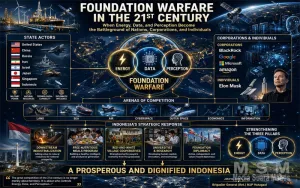
The essay introduces what Hutagaol calls Foundation Warfare Theory, a conceptual framework suggesting that contemporary competition increasingly occurs through the control of foundational systems such as economics, data, technology, information, and public perception rather than conventional military confrontation.
Hutagaol believes the central challenge facing democracy today is not merely who governs, but how political legitimacy is created, financed, communicated, and sustained within an increasingly complex digital environment.
In another section, he emphasizes that the state must remain stronger than concentrated economic power. While investment, innovation, and economic growth are essential for national development, all economic activities must operate within constitutional boundaries and serve the public interest.
“Capital should serve the nation, not the nation become subordinate to capital,” he stressed.
He further underscores the importance of transparent political financing, accountable public institutions, independent journalism, digital literacy, and ethical governance of Artificial Intelligence to safeguard democracy and national sovereignty.
Concluding his essay, Hutagaol reminds readers that the instruments of power continue to evolve. While influence in the 17th century was built through trading fleets and commercial monopolies, influence in the 21st century is increasingly shaped by capital, data, algorithms, Artificial Intelligence, and public perception.
For this reason, he argues that the future of democracy and national sovereignty will largely depend on a state’s ability to uphold constitutional integrity, strengthen institutions, promote ethical leadership, and ensure that all forms of power remain accountable to the people.
“Democracy will remain genuine when leaders are chosen through public trust rather than financial superiority or informational dominance.”

Jurnalis : Suwoto
Bergabung di Media Suara Mabes (MSM) sejak tanggal 26 April 2021 sebagai Redaktur. Email : suwoto@mediasuaramabes.co.id











Saat ini belum ada komentar